
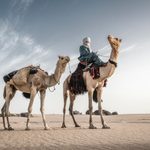
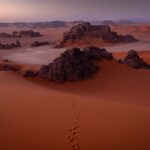
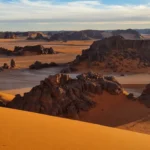
There is a moment, somewhere past the last palm grove of Djanet, when the road simply stops being a road. The asphalt gives way to a track, the track gives way to open sand, and the horizon — which a moment ago belonged to a small oasis town — suddenly belongs to no one at all. This is where Algeria's deep Sahara begins. And for those willing to leave the paved world behind, it opens onto Tadrart Rouge and one of the most staggering landscapes left on Earth.
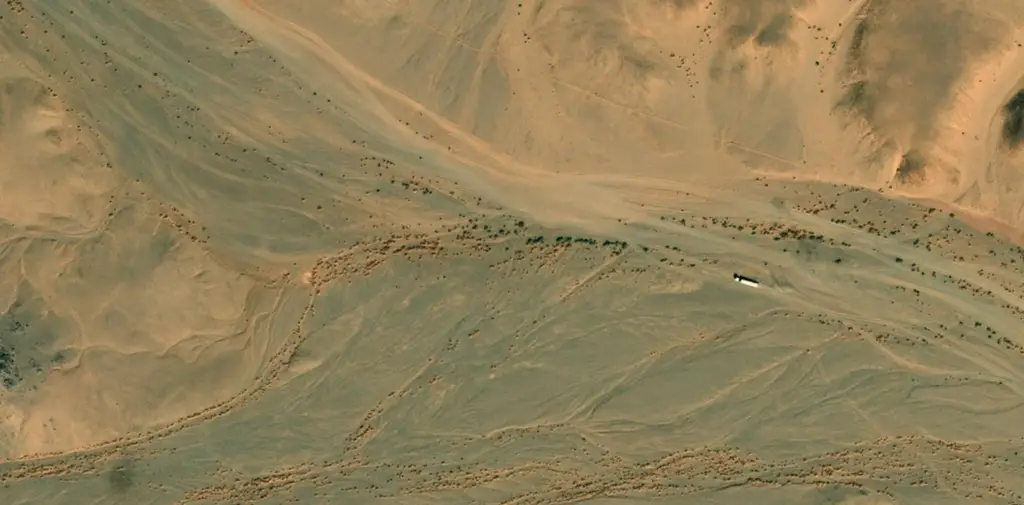
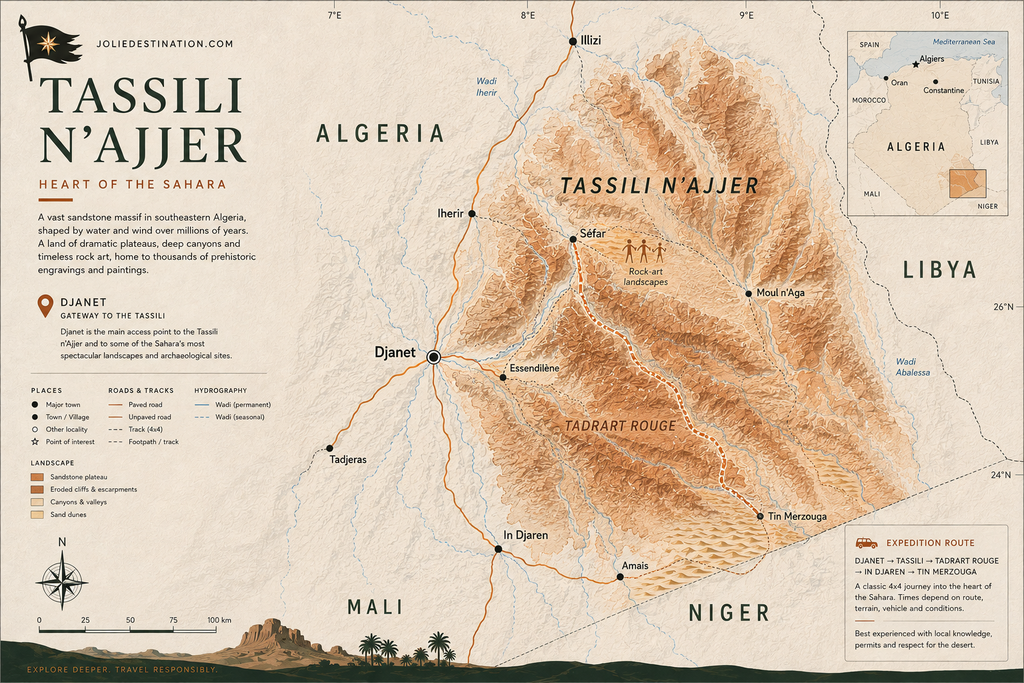
Djanet sits in the far southeast of Algeria, closer to the borders of Libya and Niger than to any Algerian city most travelers could name. It is a small oasis, green and unhurried, ringed by date palms and mudbrick. But Djanet has never really been a destination in itself. For centuries it has been something more interesting: a threshold. A place where caravans once gathered before vanishing into the dunes, and where expeditions still do today.
Beyond it lies Tassili n’Ajjer — a plateau so vast, so strange, and so old that it feels less like a place than like a memory the desert refuses to let go of.
A Landscape That Remembers
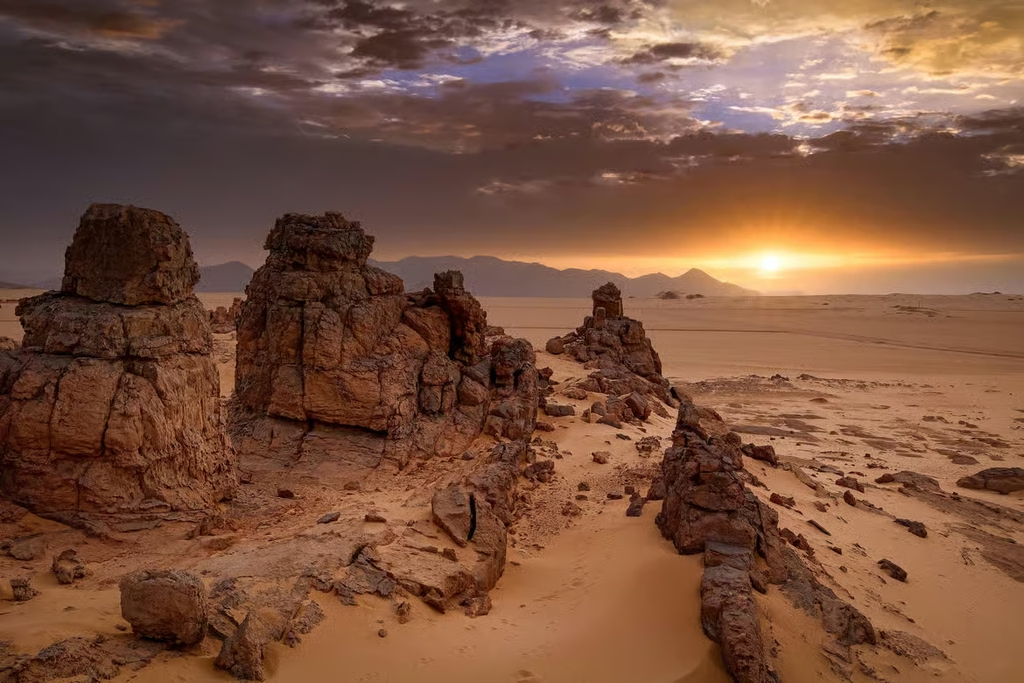
To stand on the Tassili plateau is to stand somewhere the desert hasn’t finished becoming itself. Sandstone towers rise out of the ground in shapes that look sculpted rather than eroded — spires, arches, corridors, whole cathedrals of stone shaped by wind and water over millions of years. Early explorers compared it to a lunar landscape, and the comparison still holds. There are places on Tassili where nothing moves, nothing grows, and the silence has a kind of weight to it.
And yet this emptiness is deceptive. Scattered across the plateau — on cliff faces, inside shallow rock shelters, along canyon walls — are more than 15,000 engravings and paintings, some among the oldest visual records of human life anywhere on the planet. Antelope, cattle, hippopotamus, figures caught mid-dance or mid-hunt: a visual archive of a Sahara that was once green, once wet, once teeming with the animals of a savanna rather than a desert. Tassili doesn’t just show you a landscape. It shows you a vanished world layered underneath this one.
It’s this combination — the almost otherworldly geology and the depth of human history pressed into it — that led UNESCO to recognize Tassili n’Ajjer for both its natural and cultural significance. But no designation quite prepares you for what it feels like to walk it: to realize that the silence around you has been witnessed, painted, and remembered for thousands of years.
Where the Desert Turns Red: Tadrart Rouge
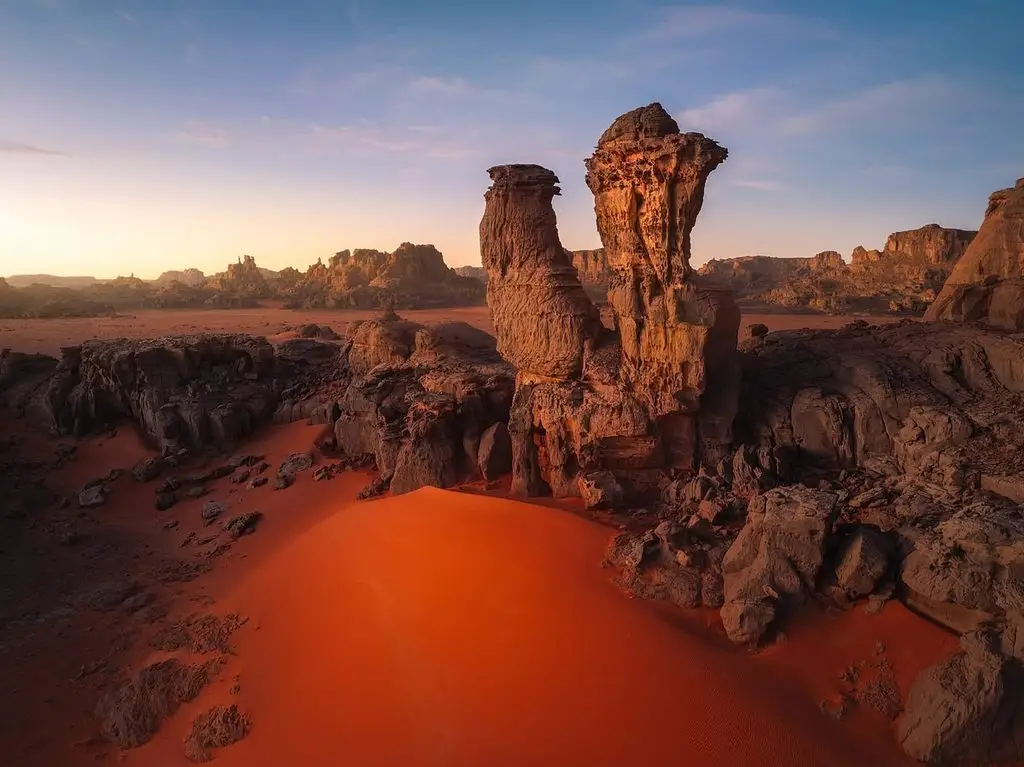
South of Djanet, the desert changes character entirely. This is Tadrart Rouge — a region where the sandstone itself seems to catch fire, glowing deep orange and red against pale dunes that shift and re-form with every wind. If Tassili feels ancient and monumental, Tadrart Rouge feels intimate and alive: narrow canyons, natural arches, dunes that curl against rock walls like something poured rather than blown into place.
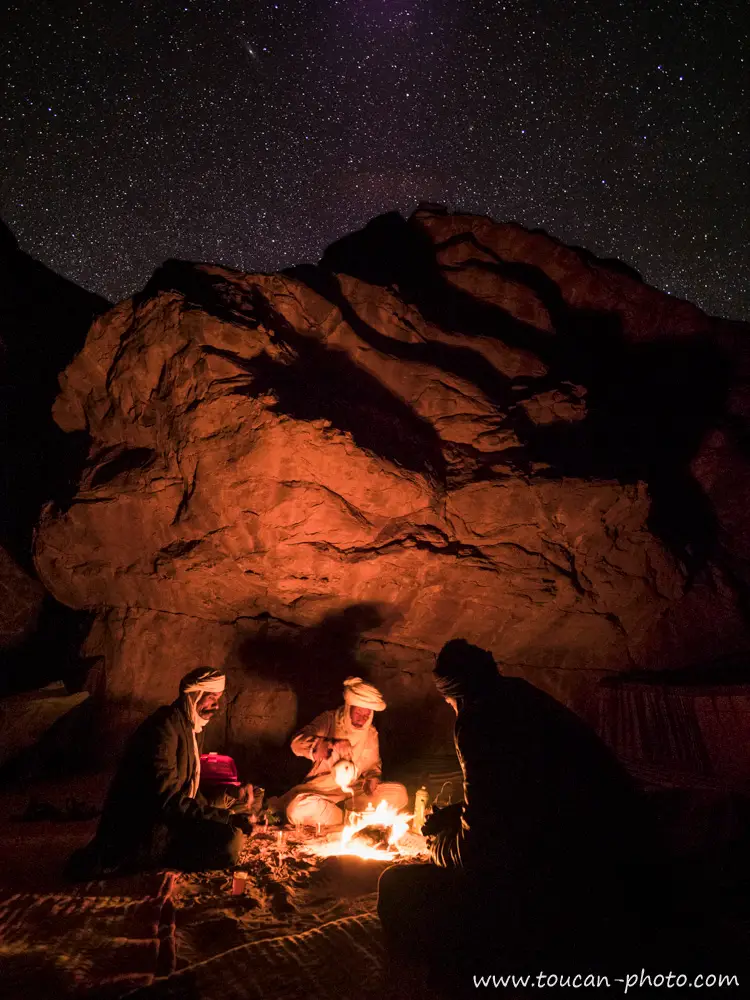
Travelers who make it this far tend to describe the same thing — a sense of scale that stops being abstract. The rock formations are large enough to dwarf a person standing beside them, and the silence is large enough to dwarf conversation. Nights here are spent under skies unpolluted by any artificial light for hundreds of kilometers in every direction — the kind of dark that makes the Milky Way look less like a smudge and more like a structure.
Valleys the Sahara Forgot to Dry Out
Not every corner of this region conforms to the desert’s usual rules. Tucked within the folds of Tassili are places like Essendilène and Iherir — valleys where water still gathers in pools shaded by ancient trees, a strange and welcome contradiction in a landscape defined by its absence of water. Nearby, Tikoubaouine offers its own dramatic sandstone architecture, while the dunes of Erg Admer provide the kind of pure, sweeping desert scenery most people picture when they imagine the Sahara at all.
Each of these places rewards travelers with something different — water and shade in one valley, towering red rock in another, an ocean of sand in a third. Together, they turn the region around Djanet into something far richer than the single, monotonous “sea of dunes” the Sahara is so often reduced to in imagination.
A Living Desert, Not Just an Ancient One
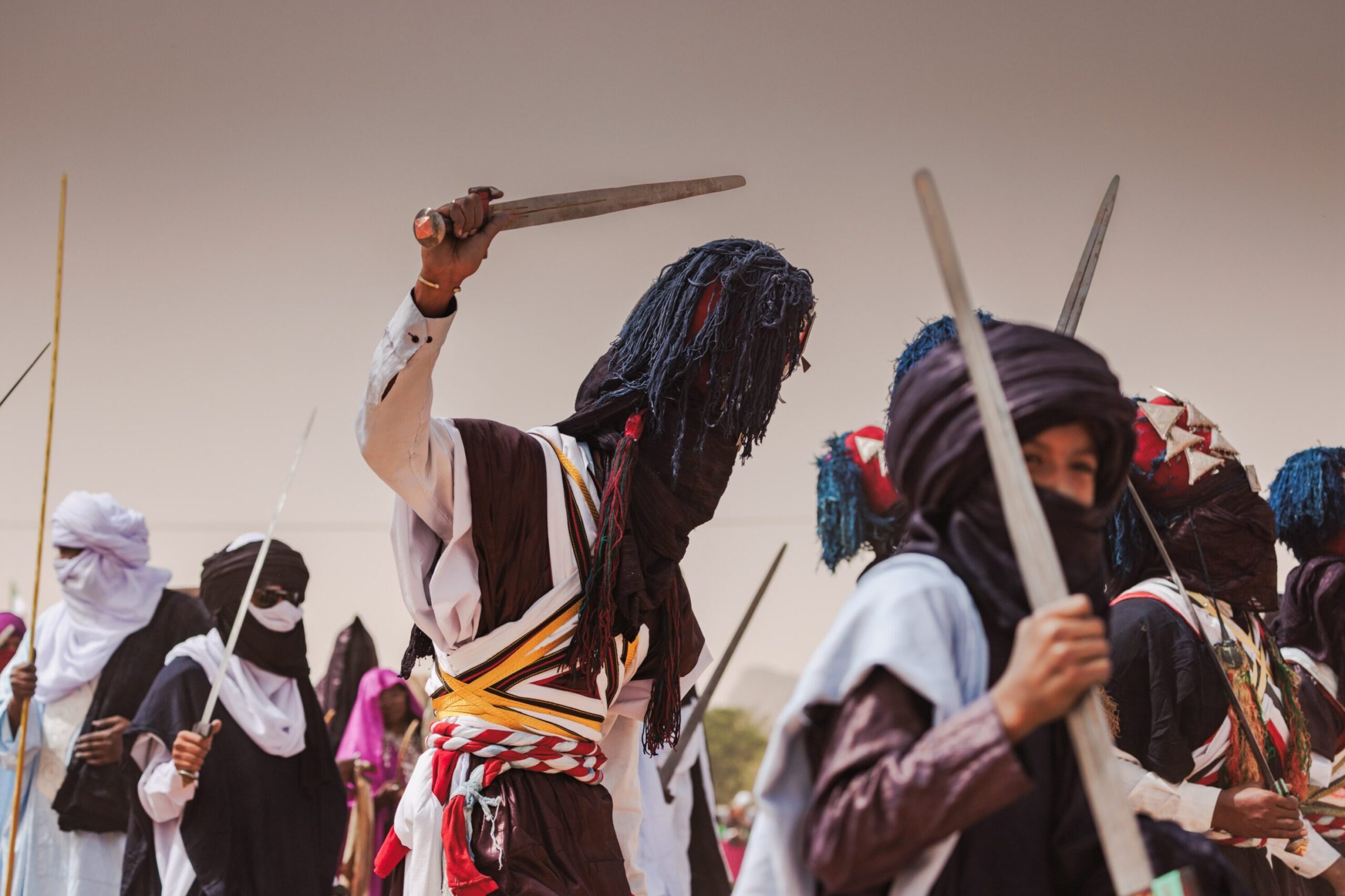
Djanet’s story doesn’t end in prehistory. The town remains home to Tuareg communities whose traditions are very much alive today, nowhere more vividly than in Sebeïba — an annual ritual recognized by UNESCO as part of the world’s Intangible Cultural Heritage. For ten days, two communities of Djanet prepare through song, dance and ceremony, culminating in a ritual said to trace back some three thousand years, its origins tangled in legend: a celebration of peace after an ancient victory, or the resolution of a long-forgotten rivalry, depending on who tells the story.
It’s a reminder that this landscape isn’t a museum. The Sahara around Djanet is not only a place where history is written into rock — it’s a place where culture continues to be written, generation after generation, in the same sand.
Field Notes & Practical Logistics
Planning a journey into Tadrart Rouge requires a few specific steps, as independent travel in this part of the Sahara is neither permitted nor practically feasible.
- Local Agencies & Guides: By Algerian regulation, travelers venturing into Tassili n’Ajjer National Park must be accompanied by an authorized local desert agency and Tuareg guides. They handle navigation, cook support, camp setup, and necessary park permits.
- Visa on Arrival (VFS / Desert Visa): Algeria offers a streamlined visa-on-arrival process specifically for tourists booking through registered southern desert agencies. Your agency will provide an official invitation letter/authorization that allows you to obtain your visa upon landing at the airport in Djanet or Algiers.
- When to Go: The main expedition season runs from October through March, when daytime temperatures are manageable (20°C–28°C / 68°F–82°F). Be prepared for drastic temperature drops at night, often dipping near freezing in the high dunes during December and January.
- Getting There: Domestic flights run regularly from Algiers (ALG) to Djanet (DJG) via Air Algérie and Tassili Airlines, often operating late at night or early in the morning.
- Expedition Style: Expect full 4×4 travel across open terrain and wild camping under the stars each night. Infrastructure outside Djanet is non-existent—there is no mobile network, running water, or electricity once you enter the park, so pack adequate power banks, appropriate layers, and essential personal supplies.
These are the specifics for the Djanet route. For the wider picture — visa options, an honest safety breakdown across the north-south divide, and how this fits into a first trip to Algeria — see JolieDestination’s guide for first-time travelers.
Why Go?
There are deserts, and then there is this: a place where sandstone becomes sculpture, where valleys hold water no one expects to find, where a festival older than most nations still fills a small square with music, and where the silence outside of it all is so complete it becomes its own kind of company.
Djanet is not a checklist destination. It rewards those willing to go slowly, to camp beneath its skies, and to let the emptiness of the Sahara do what it has always done to travelers — put things back into proportion.
FAQ
Where is Djanet, Algeria located?
Djanet is an oasis town in the far southeast of Algeria, near the borders of Libya and Niger. It serves as the main gateway to the Tassili n'Ajjer plateau and the Sahara's deep desert interior.
How old is the rock art in Tassili n'Ajjer?
The rock art of Tassili n'Ajjer dates back thousands of years to a period when the Sahara was a green savanna rather than a desert. The engravings depict antelope, cattle, and hippopotamus, offering a rare visual record of a vanished, water-rich Sahara.
What is Tadrart Rouge and why is it famous?
Tadrart Rouge is a desert region south of Djanet known for its red and orange sandstone formations, narrow canyons, and sweeping dunes. It's considered one of the most visually striking parts of the Algerian Sahara, especially at sunrise and sunset.
Are there water sources in the Sahara desert near Djanet?
Yes. Hidden valleys such as Essendilène and Iherir, near Djanet, contain shaded, permanent water pools — a rare feature in the Sahara that supports vegetation and wildlife within an otherwise arid landscape.
What is the Sebeïba festival in Djanet?
Sebeïba is an annual Tuareg cultural ritual held in Djanet, Algeria, recognized by UNESCO as part of the Intangible Cultural Heritage of Humanity. Rooted in legend and said to date back roughly three thousand years, it involves ten days of music, dance, and ceremony.
Is Djanet, Algeria worth visiting?
Djanet and the surrounding Tassili n'Ajjer region are considered among the Sahara's most rewarding destinations, offering ancient rock art, dramatic desert landscapes, and living Tuareg culture rarely found together in one place.

[…] Djanet to Tadrart Rouge: Algeria’s Deep Sahara 24/08/2026 Djanet, Algeria: An Expedition & Photography Guide to Tassili n’Ajjer 23/08/2026 View full journal → […]
[…] International Travelers 04/09/2026 Algeria for First-Time International Travelers 04/09/2026 Djanet to Tadrart Rouge: Algeria’s Deep Sahara 24/08/2026 Djanet, Algeria: An Expedition & Photography Guide to Tassili n’Ajjer 23/08/2026 View […]
[…] International Travelers 04/09/2026 Algeria for First-Time International Travelers 04/09/2026 Djanet to Tadrart Rouge: Algeria’s Deep Sahara 24/08/2026 Djanet, Algeria: An Expedition & Photography Guide to Tassili n’Ajjer 23/08/2026 View […]